

AI Risk Management Framework
Artificial intelligence (AI) technologies have significant potential to transform society and people’s lives from commerce and health to transportation and cybersecurity to the environment and our planet. AI technologies can drive inclusive economic growth and support scientific advancements that improve the conditions of our world. AI technologies, however, also pose risks that can negatively impact individuals, groups, organizations, communities, society, the environment, and the planet. Like risks for other types of technology, AI risks can emerge in a variety of ways and can be characterized as long or short-term, high or low probability, systemic or localized, and high- or low impact.
Artificial Intelligence is no longer a futuristic concept; it is the engine driving modern business, healthcare, national security, and daily life. However, as AI systems become more autonomous and integrated into critical decision making, the risks they pose from biased hiring algorithms to hallucinating chatbots and volatile financial models have become impossible to ignore.
NIST AI RMF 1.0
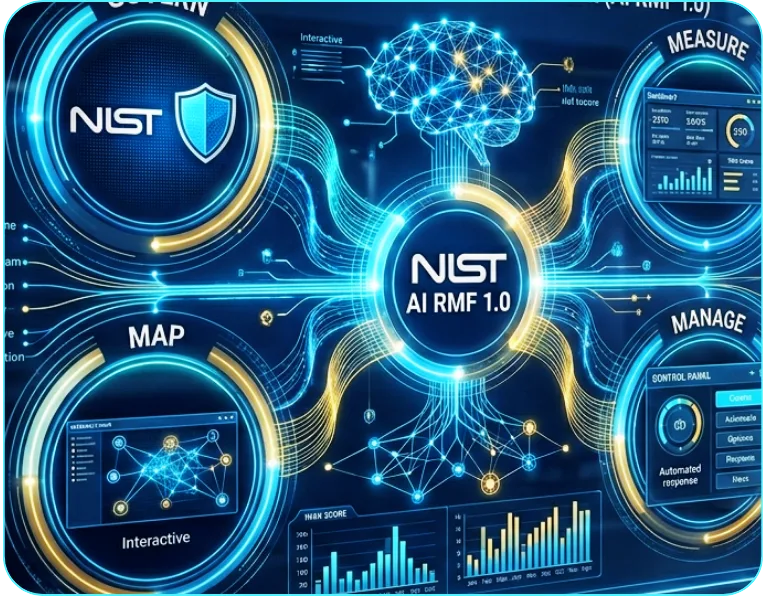
NIST’s AI RMF 1.0 is a voluntary, technology and sector agnostic framework for managing risks arising from AI systems across their lifecycle. It starts by defining AI as socio-technical: impacts emerge not only from models and data, but from how people build, deploy, and use them. AI risks differ from traditional software, outlines key trustworthiness characteristics (valid and reliable, safe, secure and resilient, accountable and transparent, explainable and interpretable, privacy-enhanced, and fair with harmful bias managed), and highlights challenges in measuring and prioritizing risk. These encompasses four core functionalities ie. GOVERN, MAP, MEASURE, MANAGE, each broken into categories and subcategories that organizations can tailor.
As artificial intelligence (AI) rapidly transforms industries, governments, and daily life, the need for structured approaches to managing its risks has never been more critical. From biased hiring algorithms to autonomous vehicle failures, the potential harms of poorly governed AI systems are vast and well-documented. Recognizing this urgency, the National Institute of Standards and Technology (NIST) a non-regulatory agency of the U.S. Department of Commerce released the AI Risk Management Framework (AI RMF 1.0) in January 2023
This landmark framework provides organizations of all sizes and sectors with a structured, flexible, and voluntary approach to identifying, assessing, and mitigating risks associated with AI systems. It represents a pivotal moment in the global conversation about responsible AI, offering a common language and a practical roadmap for building trustworthy AI.
The Need for AI Risk Management
AI systems are increasingly embedded in high-stakes, domains healthcare diagnostics, criminal justice, financial lending, employment screening, and national security, among others. While AI offers transformative benefits, it also introduces unique risks that traditional risk management approaches may not adequately address. These risks include:
- Bias and discrimination embedded in training data or model design.
- Lack of transparency and explainability in complex models.
- Privacy violations through data collection and inference.
- Safety failures in physical systems such as autonomous vehicles and medical devices.
- Security vulnerabilities including adversarial attacks and data poisoning.
- Societal harms such as misinformation, job displacement, and erosion of trust.
Unlike conventional software, AI systems are often probabilistic, adaptive, and opaque. They learn from data that may reflect historical inequalities, and their behavior can change over time. These characteristics demand a tailored approach to risk management one that the NIST AI RMF aims to provide.
Legislative and Policy Context
The development of the AI RMF was mandated by the National Artificial Intelligence Initiative Act of 2020 and further directed by Executive Order 14110 on the “Safe, Secure, and Trustworthy Development and Use of Artificial Intelligence” (October 2023). The framework aligns with broader U.S. policy goals of promoting innovation while safeguarding civil rights, privacy, and public safety.
NIST engaged in an extensive, multi-year development process involving workshops, public comments, and collaboration with stakeholders from academia, industry, civil society, and government. The result is a framework that is both rigorous and accessible.
Structure of the NIST AI RMF
The AI RMF is organized into two main parts:
Part 1: Foundational Information for the Framework
This section lays the groundwork by discussing:
- The scope and purpose of the framework.
- Characteristics of trustworthy AI, which serve as the guiding principles.
- Understanding and framing AI risk, including how AI risks differ from traditional technology risks.
Part 2: Core Functions and Actions
The four core functions of the framework – Govern, Map, Measure, and Manage each broken down into categories and subcategories of specific actions.
Characteristics of Trustworthy AI
Before diving into the core functions, it is essential to understand what NIST considers a “trustworthy” AI system. The framework identifies seven key characteristics:
Valid and Reliable — The AI system performs as intended and produces accurate, consistent outputs.
Safe — The system minimizes potential harm to people, property, and the environment.
Secure and Resilient — The system is protected against attacks, unauthorized access, and disruptions.
Accountable and Transparent — There is clarity about who is responsible for the system’s behavior, and its operations are understandable.
Explainable and Interpretable — Stakeholders can understand how the system makes decisions and what factors influence outcomes.
Privacy-Enhanced — The system protects personal data and upholds individuals’ privacy rights.
Fair — With Harmful Bias Managed — The system avoids unjust discrimination and actively mitigates harmful biases.
These characteristics are not checklists but aspirational goals that organizations should pursue throughout the AI lifecycle.
The Four Core Functions
The heart of the AI RMF lies in its four core functions: Govern, Map, Measure, and Manage. These functions are interconnected, iterative, and designed to be applied at every stage of an AI system’s lifecycle — from conception to deployment to retirement.
1. GOVERN
Purpose: Establish and maintain the policies, processes, and organizational structures necessary for effective AI risk management.
The Govern function is the foundation of the entire framework. It emphasizes that AI risk management is not merely a technical exercise but an organizational and cultural one. Key activities include:
- Defining roles and responsibilities for AI risk management across the organization.
- Establishing a culture of risk awareness where all stakeholders from executives to developers to end-users understand their role in managing AI risks.
- Developing policies and procedures for AI governance, including documentation standards, review processes, and escalation protocols.
- Ensuring legal and regulatory compliance with applicable laws, regulations, and industry standards.
- Engaging stakeholders — including affected communities in the governance process to ensure diverse perspectives are considered.
- Allocating resources for AI risk management activities, including training, tools, and personnel.
- Managing third-party risks, including those associated with externally sourced data, models, and AI services.
Why it matters: Without strong governance, even the most sophisticated technical measures can fail. Governance ensures that risk management is systematic, sustained, and aligned with organizational values and societal expectations.
2. MAP
Purpose: Contextualize AI risks by identifying and understanding the broader environment in which the AI system operates.
The Map function focuses on the context of the AI system, its intended use, potential impacts, and the ecosystem in which it exists. Key activities include:
- Defining the intended purpose of the AI system and its expected benefits.
- Identifying potential impacts on individuals, communities, organizations, and society.
- Assessing the context of use, including the environment, users, and affected populations.
- Identifying potential failure modes and sources of risk, including data quality issues, model limitations, and deployment challenges.
- Evaluating the risk tolerance of the organization and its stakeholders.
- Documenting assumptions and limitations that may affect the system’s performance.
- Identifying interdependencies with other systems, processes, and stakeholders.
Why it matters: Risks are context-dependent. An AI system that is perfectly acceptable in one context may be highly problematic in another. The Map function ensures that organizations understand the full landscape of potential risks before moving forward.
3. MEASURE
Purpose: Employ quantitative and qualitative methods to analyze, assess, and monitor AI risks.
The Measure function provides the tools and techniques for evaluating AI risks in a systematic and rigorous manner. Key activities include:
- Selecting appropriate metrics for assessing AI risks, including fairness metrics, accuracy metrics, robustness metrics, and privacy metrics.
- Collecting and analyzing data on the AI system’s performance, behavior, and impacts.
- Conducting testing and evaluation, including bias audits, red-teaming exercises, and stress tests.
- Monitoring the system over time to detect changes in performance, behavior, or risk profile.
- Benchmarking against established standards, best practices, and comparable systems.
- Documenting measurement results and making them available to relevant stakeholders.
- Using feedback loops to continuously improve measurement approaches.
Why it matters: You cannot manage what you cannot measure. The Measure function provides the evidence base for informed decision-making and helps organizations track the effectiveness of their risk mitigation efforts.
4. MANAGE
Purpose: Prioritize and act on AI risks, implementing strategies to mitigate, transfer, accept, or avoid identified risks.
The Manage function translates insights from the Map and Measure functions into concrete action. Key activities include:
- Prioritizing risks based on their likelihood, severity, and organizational risk tolerance.
- Implementing risk mitigation strategies, including technical measures (e.g., bias correction, adversarial training), organizational measures (e.g., policy changes, training), and procedural measures (e.g., human oversight, review processes).
- Developing incident response plans for AI-related failures and harms.
- Communicating risks and mitigation efforts to relevant stakeholders, including affected individuals and communities.
- Documenting decisions and their rationale for accountability and future reference.
- Continuously reassessing risks and adjusting mitigation strategies as the AI system and its environment evolve.
- Establishing mechanisms for redress by providing affected individuals with avenues to report concerns and seek remedies.
Why it matters: Risk management without action is merely risk identification. The Manage function ensures that organizations take proactive steps to minimize harm and maximize the benefits of their AI systems.
The AI RMF Playbook
To help organizations implement the core functions, NIST published an accompanying AI RMF Playbook — a living document that provides suggested actions, practical guidance, and references for each subcategory of the core functions. The Playbook is not prescriptive; rather, it offers a menu of options that organizations can tailor to their specific needs, resources, and risk profiles.
This covers topics such as:
- How to conduct an AI impact assessment.
- How to engage affected communities in the risk management process.
- How to document AI systems for transparency and accountability.
- How to measure fairness and bias in AI systems.
- How to establish human oversight mechanisms.
Its regularly updated to reflect new developments in AI technology, research, and policy.
In addition to the core framework and Playbook, NIST has developed several supplementary resources:
Generative AI Profile (NIST AI 600-1): Released in 2024, this profile addresses the unique risks associated with generative AI systems, including hallucinations, misinformation, and intellectual property concerns.
Secure Software Development Framework (SSDF): Provides guidance on integrating security into the AI software development lifecycle.
AI RMF Crosswalk: Maps the AI RMF to other frameworks and standards, including ISO/IEC 23894, the OECD AI Principles, and the EU AI Act, helping organizations align their compliance efforts.
Practical Implementation: A Step-by-Step Approach
For organizations looking to implement the NIST AI RMF, the following step-by-step approach can serve as a starting point:
Step 1: Establish Governance
- Appoint an AI risk management lead or team.
- Develop an AI governance policy that aligns with organizational values and legal requirements.
- Define roles, responsibilities, and accountability structures.
Step 2: Inventory AI Systems
- Create a comprehensive inventory of all AI systems within the organization.
- Document each system’s purpose, data sources, model architecture, and deployment context.
Step 3: Conduct a Risk Assessment (Map)
- For each AI system, identify potential risks and impacts.
- Assess the context of use, including affected populations and potential failure modes.
Step 4: Measure and Evaluate (Measure)
- Select appropriate metrics and evaluation methods.
- Conduct testing, auditing, and monitoring to assess the system’s risk profile.
Step 5: Develop and Implement Mitigation Strategies (Manage)
- Prioritize risks and develop action plans.
- Implement technical, organizational, and procedural measures to mitigate identified risks.
Step 6: Monitor, Review, and Iterate
- Continuously monitor AI system performance and risk profile.
- Update risk assessments and mitigation strategies as needed.
- Incorporate lessons learned into future AI development and deployment.
Significance and Impact
Since its release, the NIST AI RMF has had a significant impact on the AI governance landscape:
Adoption by federal agencies: U.S. federal agencies are increasingly incorporating the AI RMF into their AI governance practices, as directed by Executive Order 14110.
Influence on legislation: The framework has informed legislative proposals and regulatory initiatives at both the state and federal levels.
Industry adoption: Many leading technology companies and organizations have adopted or aligned their AI governance practices with the AI RMF.
International influence: The framework has contributed to global conversations about AI governance and has been referenced in international standards and policy discussions.
Research and academia: The AI RMF has become a foundational reference in academic research on AI governance, ethics, and risk management.
Challenges and Limitations
While the NIST AI RMF is widely praised, it is not without challenges:
Voluntary nature: As a voluntary framework, its adoption depends on organizational willingness. Critics argue that voluntary frameworks may be insufficient to address systemic AI risks.
Complexity: Implementing the framework can be resource-intensive, particularly for small and medium-sized enterprises (SMEs) with limited budgets and expertise.
Rapidly evolving technology: The pace of AI development — particularly in areas like generative AI — means that the framework must be continuously updated to remain relevant.
Measurement challenges: Quantifying AI risks, particularly in areas like fairness and explainability, remains an active area of research with no universally agreed-upon standards.
Global coordination: As AI is a global technology, the lack of a unified international framework can create compliance challenges for organizations operating across jurisdictions.
The Future of the NIST AI RMF
NIST is committed to evolving the AI RMF in response to new developments in AI technology, research, and policy. Key areas of future work include:
- Expanding the GenAI Profile to address emerging risks associated with increasingly capable generative AI systems.
- Developing sector-specific profiles for high-risk domains such as healthcare, finance, and criminal justice.
- Enhancing the Playbook with more practical examples, case studies, and implementation guidance.
- Strengthening international collaboration with counterpart organizations in other countries to promote interoperability and harmonization.
- Incorporating advances in AI measurement including new methods for evaluating fairness, robustness, and transparency.
The NIST AI Risk Management Framework represents a landmark achievement in the governance of artificial intelligence. By providing a structured, flexible, and comprehensive approach to AI risk management, it empowers organizations to build and deploy AI systems that are not only innovative but also trustworthy, safe, and fair.
In a world where AI is becoming ubiquitous, the AI RMF offers a compass not a rigid map for navigating the complex terrain of AI risks. Its strength lies in its adaptability, its emphasis on context, and its recognition that AI risk management is a continuous, collaborative, and evolving endeavor.
For organizations seeking to harness the power of AI while managing its risks responsibly, the NIST AI RMF is an indispensable resource. As AI continues to evolve and reshape our world, frameworks like this will play a critical role in ensuring that the technology serves humanity’s best interests.